In Bajtazar's garden grows a tree. It consists of $n$ nodes, numbered from $1$ to $n$, where $n$ is even, and has $n - 1$ edges, each directly connecting two nodes. Furthermore, as is usually the case in trees, there is exactly one simple path between every pair of nodes.
In Byteland, Flag Day is approaching, so Bajtazar decided to color half of the nodes of his tree white and half black, so that it resembles the flag of Byteland (as Bytelanders value harmony and symmetry, their flag consists of half white and half black color). We call any such coloring a flag coloring.
Bajtazar would not be himself, however, if he did not have his whims. He stated that the beauty of a flag coloring depends on the sum of distances between all pairs of nodes of the same color, where by the distance between a pair of nodes we mean the number of edges on the path connecting them.
Bajtazar wants this sum to be as large as possible. Help him and find this maximum sum and any flag coloring that achieves it!
Input
The first line of input contains one even number $n$ ($1 \le n \le 10^6$) representing the number of nodes in the tree. The next $n-1$ lines contain the description of the edges. The $i$-th of these lines (for $1 \le i \le n-1$) contains two integers $a_i, b_i$ ($1 \le a_i, b_i \le n, a_i \neq b_i$) meaning that nodes $a_i$ and $b_i$ are directly connected by an edge.
Output
The first line of output should contain the maximum sum of distances between pairs of nodes of the same color in a flag coloring of the given tree. The second line should contain a string consisting of $n$ characters describing the flag coloring that achieves this sum. In this string, the $i$-th character (for $1 \le i \le n$) is 0 if node $i$ is colored white, or 1 if it is colored black.
Examples
Input 1
6
1 2
2 4
2 3
1 5
5 6
Output 1
14
011001
Note
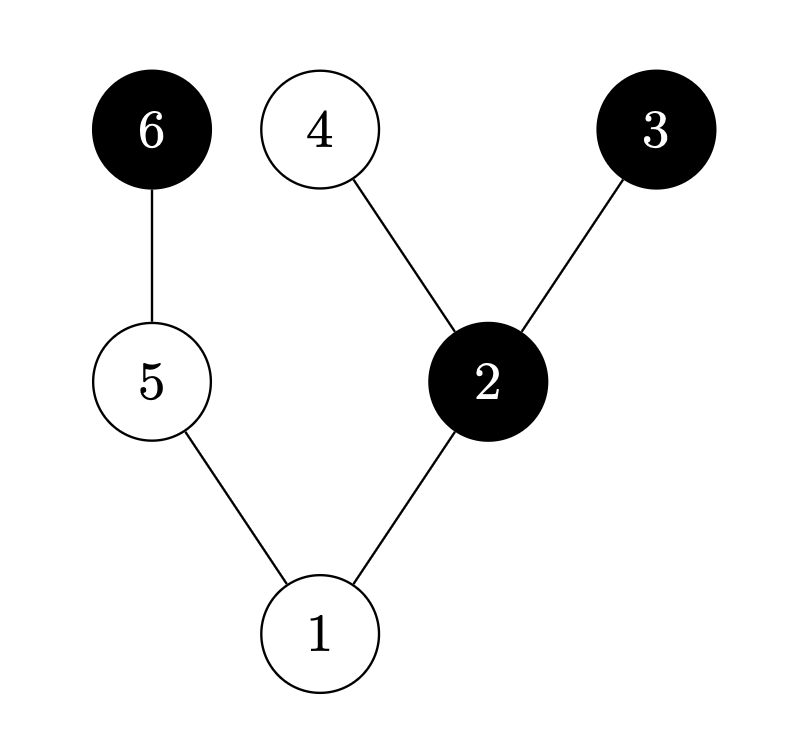
The tree from the example above is shown in the figure below. The nodes are colored according to the example output given above. The paths between white nodes are the paths between nodes 1 and 5 (length 1), 1 and 4 (length 2), and 5 and 4 (length 3). The paths between black nodes are the paths between nodes 2 and 3 (length 1), 2 and 6 (length 3), and 3 and 6 (length 4). The total sum of the lengths of these paths is $1 + 2 + 3 + 1 + 3 + 4 = 14$. It can be verified that it is not possible to obtain a larger sum of path lengths between nodes of the same color.
Sample tests
Test 0a is the test from the example above. Additionally:
- 0b: $n = 16$ and node $i$ is connected to node $i-2$ for $3 \le i \le n$. Additionally, node 8 is connected to node 9.
- 0c: $n = 24$ and all nodes with numbers greater than 1 are connected to node 1.
- 0d: $n = 5000$ and nodes from 3 to 2501 are connected to node 1, nodes from 2502 to 5000 are connected to node 2. Additionally, node 1 is connected to node 2.
- 0e: $n = 100\,000$ and node $i$ is connected to node $i-1$ for $2 \le i \le n$.
- 0f: $n = 1\,000\,000$ and node $i$ is connected to node $\lfloor i/2 \rfloor$ for $2 \le i \le n$.
Grading
The test set is divided into the following subtasks. Tests for each subtask consist of one or more separate test groups.
| Subtask | Constraints | Points |
|---|---|---|
| 1 | $n \le 16$ | 7 |
| 2 | $n \le 24$ | 12 |
| 3 | Each node is connected to at most two other nodes | 9 |
| 4 | Each node is connected to at most three other nodes | 21 |
| 5 | $n \le 5000$ | 19 |
| 6 | $n \le 100\,000$ | 13 |
| 7 | No additional constraints | 19 |
If only the first line of your answer is correct, your solution will receive 50% of the points for that test. You do not need to output the second line to receive these points.